"There" Music: Impossible Hope
I've long had a knack for listening to a very specific sort of music. I've had difficulty fully describing it, as it's not a genre or a movement necessarily but more so a philosophical current as far as musical creation is concerned. I think it's best that I outline the main artists I think of when I think of what I like to call "there" music: David Bowie (specifically the song Heroes), Bruce Springsteen's golden era, Cameron Winter and his work across both Geese and his solo output, and all of LCD Soundsystem. What do all of these artists have in common despite all being all time favourites of mine and primarily rock acts? Their music all has this current of maddening hope in spite of immense self-deprication, a sort of unwillingness to accept the now, the "here", the limerance towards "there" always being stronger, overwhelming and blinding with the heat of stars and the energy of the demonic love of being and the hatred of not-being. It is that which drives the man in Heroes to drink; it is that which drives all of Springsteen's heroes to pursue the love of their lives and their proletarian liberation from the arm of capital and the malice of the non-existent deity that decided not to place them where they want to be; it is that which drives Cameron Winter to be in consistent longing and asking for love, the dream being verified by its own negation again and again with the persistent smile as love takes miles; it is that which Murphy sings will be found in "the night", that great unknown where you'll find the meaning of life in a disco ball.
Each one of these artists represents this current in a different way but they are unified in knowing that "there" might not really even exist, but the denial is strong, the call is too great to deny, the hate keeps pushing them and kicking them around such that they crawl ever more towards whatever it is. I'll take the time to look at each of them and how it appears in their work separately to create a unified perspective of "there" music as it appeared to me and perhaps why it is so and why it is deceptively dangerous. I've written extensively about Cameron Winter before, so I won't address him directly in this but I think it can be inferred rather directly why his music fits this narrative well.
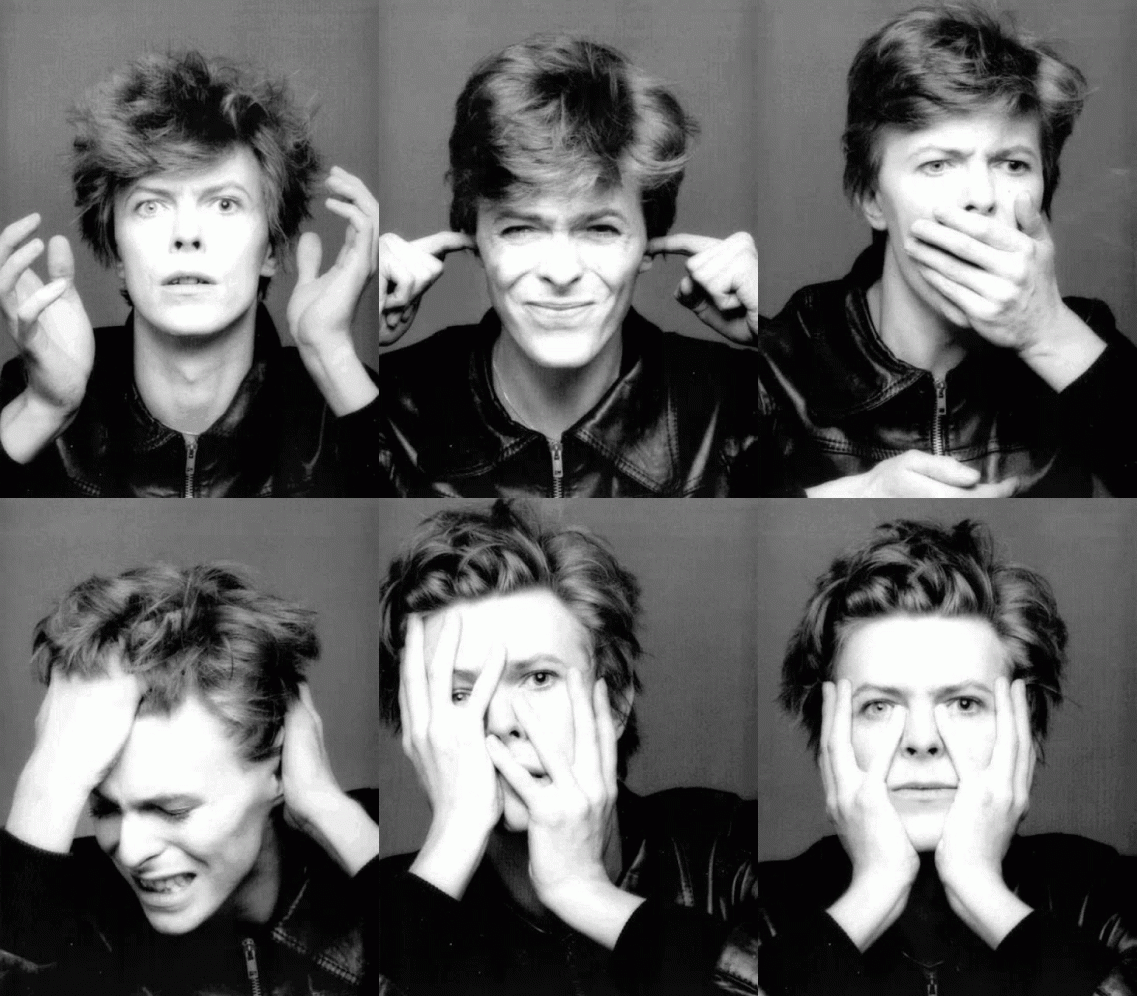
Bowie's Heroes is perhaps the greatest song ever made. It is a six minute ode to hope; the pain thereof, the love thereof, the dejection and the desparation flowing out in bursts out of the mouth of a man who had in those last few years been through hell; addiction had ravaged Bowie's soul and turned him towards some of the most extreme ideas possible, deluded him and robbed him of his capacity to be human. The Thin White Duke is a soulless apparition, for as much as that era constitutes some of Bowie's greatest music, it is also some of his most dead because the duke is fundamentally incapable of feeling love, and yes, he's wrong, it is the side effect of the cocaine. His figure is one of immense danger and one that will rip the hearts of those who approach, throwing darts in lovers' eyes. Of course, The Thin White Duke dies in essence when Bowie kicks his cocaine habit, moving to Germany and becoming someone else, occupying this middle ground in Low of attempting to recover in this new town and become someone different, the narrative reaching its peak in Heroes, the song, where he finally becomes that person, capable of true earnest feeling that is entirely uncontained by the dejection. It is this desparate calling out for things to finally be okay, and it hurts to listen to.
Heroes is a song that kills me every time I listen to it. It is a hope that will not be accomplished no matter what. It is a drunken fool ranting to his greatest beloved and attempting to showcase her beauty to her, and the folly lies in the fact that, as he sings, it is for one day that he yearns to be free of all the pain and never being able to be himself, an expression of how all of us are continually levelled in Kierkegaardian terms by our modern world, and yet the hope never dies, the craving, the feeling that this is not okay and that it should be otherwise.
Heroes is beautiful, and it is the quintessential "there" song, because it betrays the boundless pain of being a dreamer and it showcases the great failure of this view to accomodate the difficulty of being.

It manifests more consistently and more decisively in Bruce Springsteen than just about any other artist. Springsteen's music is working class in the truest sense: every last protagonist of his is caught in a spiral of hate because of capital and because of his inability to break out of the constraints of the expectations of the greater society and because he can't find the love he so desparately craves and desires. It is an ethos that formed the entire backbone of Springsteen's musical career, the man became a poet of men who wanted to prove to themselves not only their worth as men but wanted to not just be men, but to be people in the way that the patriarchy constantly denies them as the expected responsibility of their social status forces them into this subjectified role as Son, Worker, Husband, but to every last one of his men, the open road of Kerouac is much more interesting than the office.
Of course, even across different Springsteen records this manifests itself differently. Contrasting Born To Run with Darkness On The Edge Of Town seems the most immediate way of describing this. Born To Run is drunk on the fury of thunder road, Wendy and Mary and the men they love are caught in the great comedy of existence and refuse to abide by its logic, throwing themselves to the denial and to hope, "together, Wendy, we can live with the sadness, I'll love you with all the madness in my soul.."
Of course, this is a coping mechanism for the fact that they are fundamentally trapped but they are nevertheless unwilling to accept that, and all the better for them as they are empowered implicitly. Darkness On The Edge Of Town is a much more realistic depiction of the cost of such a choice; the people around refuse to believe, the men lie in hopeless dreams and kill themselves again and again for the hope of The Promised Land. That, perhaps, not only is his greatest song, but the best encapsulation of the double-edged sword that wanting to be "there" causes: an inability to accept "here" and as such, the dogs howl because howling is the only thing a limping dog can do, and we all limp towards the fountains of escape in the hope that they make cure us of the hangover we've all been lived with for so long.
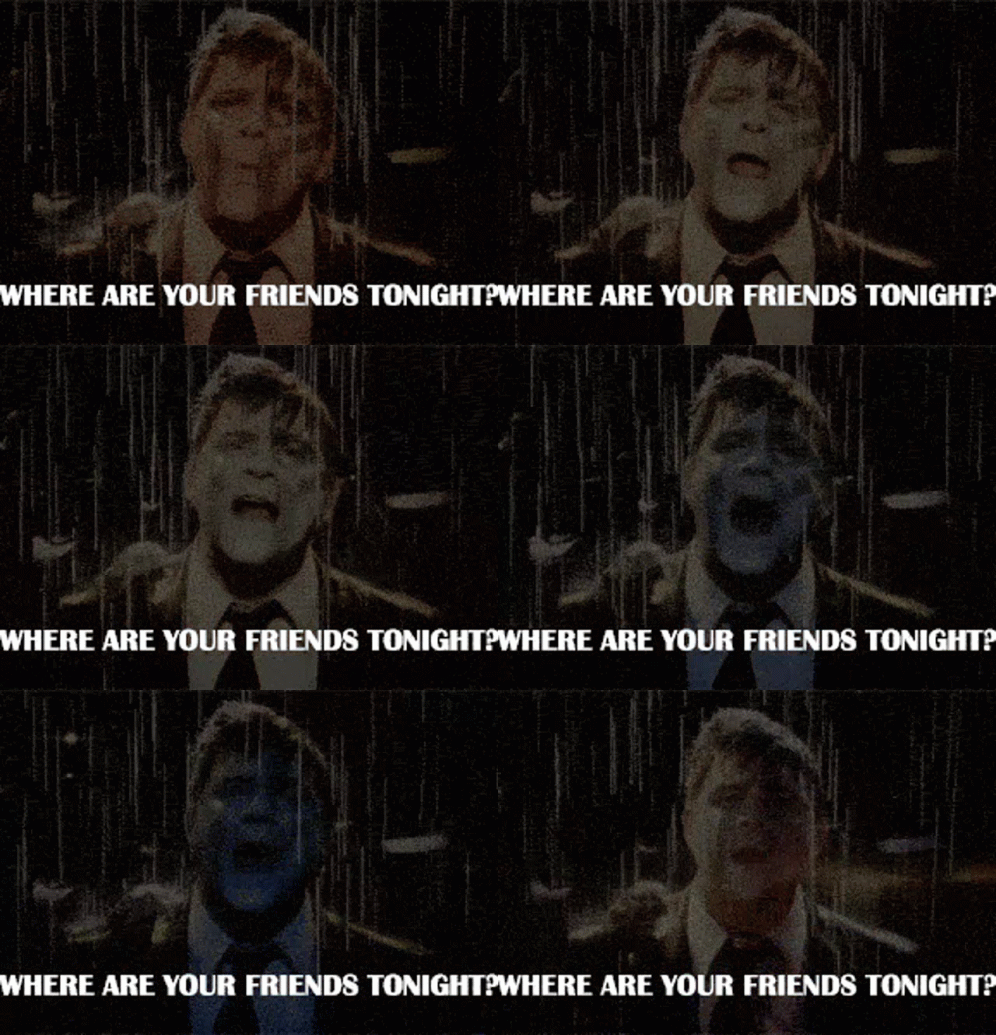
Dance into the night, fine drunkard; trip and fall on your face and break all your teeth in the process and get right back up to snort all the coke because there's dancing to do. That's what it's about with Murphy, dancing into the night only to be hit with the hangover somehow before you get sober, you can feel the eyes of everyone on you as you vomit back all your disappointment and look pathetic on the floor. Night, home, it's all nonsense to them even if you know exactly what it all means and what krautrock is and how to make a techno beat; no one cares, no one will ever care.
The music of LCD Soundsystem functions inherently off the narrative of the defiance of the great master of humankind: time. It is music that is marching against the beating drum and embraces the joy of getting older and becoming wiser and staying stupid in some way or another, of never trading the love of life for anything and never letting things stop you from appreciating it all. "There" is the night, the lyrical motif that reoccurs constantly in LCD, a fasccinating tidbit that affirms the narrative of taking matters into your own hands, but just as with all the rest, it is a distraction.
The fact of the matter is that "there" music lies to itself with the dream, and that's what makes it so beautiful. For every Born To Run, there are a thousand instances of Mary and her husband in The River, dryed out and aimless after the great fight and never finding their way out. Peace can only ever be found when it is accepted that "here" is "there" and the distinction is as pointless as immanence is from transcendence, that the lies pile up on top of one another and that the beauty of being is failure and that it is okay to hurt.
These artists are all ones that I had a bad tendency to become intensely maladaptive over, their music creating fantasies of escape for as much as they gave me the fire to go on and bred the love of life in my heart. I have come to understand that I was, in Springsteen terms, telling myself lies, those were the dreams that left me nothing but lost and brokenhearted. It is with lamentation that one has to understand there is no ultimate answer, no key to the door, we're all bashing our heads against it, and with that, one must grow to enjoy the taste of their own blood dripping down their skull from how hard they've beat themselves up against the fictitious gates of non-existent eternity. There is much love in the world, but love starts in one's heart first and foremost and is projected outwards evermore, because we are gods of our own worlds, lord up on our own hills, and we must shine the beacon down, but understand that we are part of the world nonetheless and that we need the light to shine on us all the same as well, that it is okay to want to be "there" insofar as that does impair your ability to be "here." All that matters is the fire of life and love, one and the same, burning whilst you drown in the trenches for that will be your salvation, your baptism, your triumph and your lifeboat.